
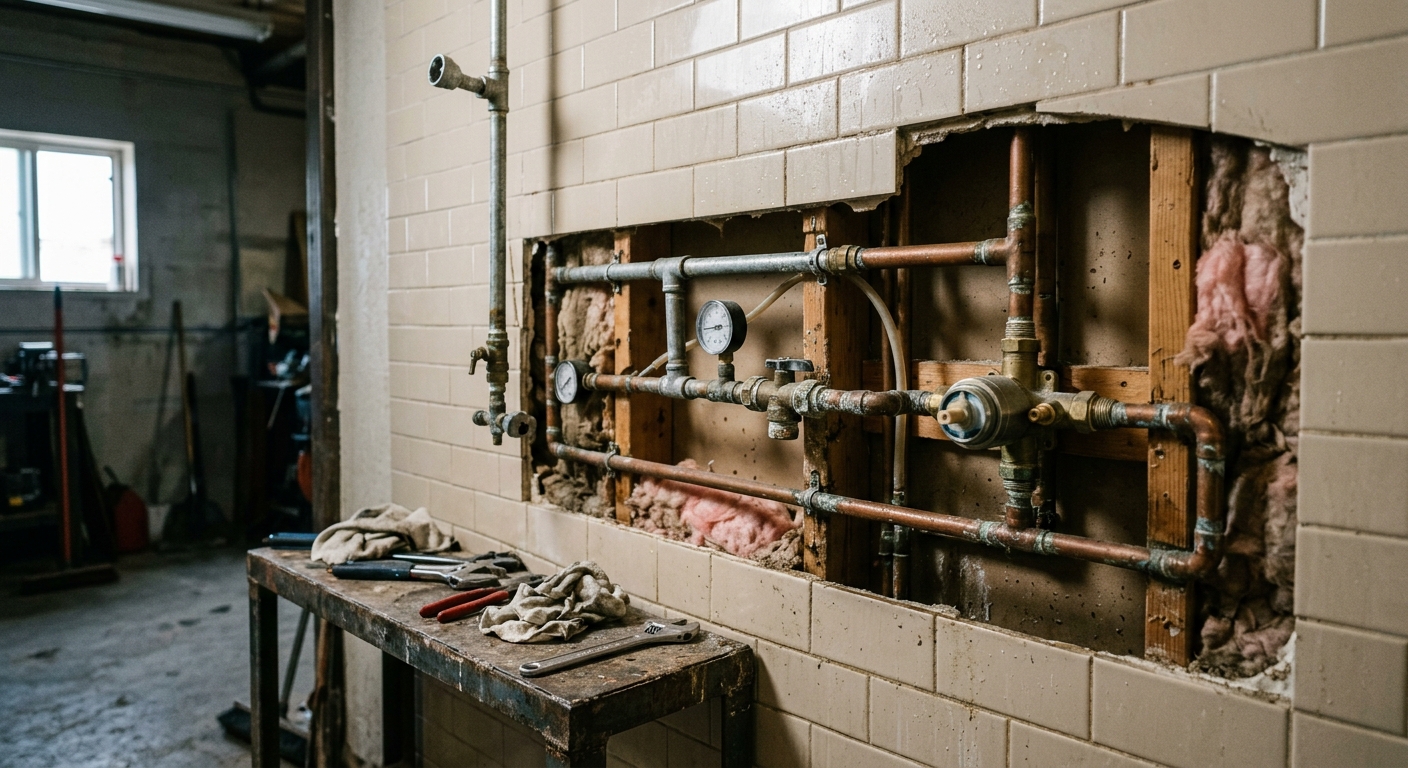
A whistling or squealing shower almost always comes from one of three places: a worn cartridge, a pressure-balancing valve working against a bad supply condition, or a partially clogged aerator or flow restrictor. The pitch and timing of the noise tell you which one. But the fixture cause matters less to a guest than what they do next, and what guests do next is write a review that mentions “noisy,” “old,” or “gross,” none of which describe the actual plumbing problem but all of which hit your survey score the same way.
What Guests Actually Report vs What’s Really Happening
Guests don’t diagnose plumbing. They report sensory impressions, and those impressions get translated into judgments about property condition. A whistle at low flow becomes “the pipes are old.” A squeal on shutoff becomes “something’s broken.” A screech at full pressure becomes “gross” or “sounds like it’s going to break.” None of these are technically accurate, but all of them land in the same review categories that affect booking conversion: cleanliness, maintenance, value.
The operational problem is that noise complaints rarely arrive as work orders. They arrive as star ratings and text reviews, often days after the guest has checked out and the fixture has been “fixed” by nobody. That lag is why noise needs to be treated as a measurable defect with a triage path, not an occasional annoyance that housekeeping notices and shrugs off.
Worn Cartridges and Washer Squeal
Cartridge type determines both the failure mode and the sound. Compression cartridges (the traditional rubber-washer-and-seat design) squeal when the washer hardens or deforms and starts vibrating against the valve seat as water passes over it. The sound is typically higher-pitched and intermittent, often worse at partial flow when the guest is adjusting the handle to find a temperature, because that’s when the washer is fluttering against the seat rather than seated fully open or closed.
Ceramic disc cartridges fail differently. They don’t have a rubber element to harden, but the discs can develop mineral scoring or a mineral film that disrupts the smooth mating surface. The resulting noise is usually a lower, steadier hum or drone rather than a squeal, and it tends to be consistent across the flow range rather than concentrated at low flow. If housekeeping or engineering reports “constant noise” versus “noise only when adjusting,” that distinction alone tells you whether you’re likely dealing with a disc or compression cartridge before anyone opens the valve body.
- Compression cartridge, intermittent squeal at partial flow: washer is hardened or misseated, replace washer or cartridge.
- Ceramic disc, steady hum across flow range: mineral scoring on disc face, cartridge replacement needed, cleaning rarely resolves it.
- Either type, noise only on shutoff: check valve seat or cartridge seal, not the aerator.
Pressure-Balancing Valves and Whistle Points
Pressure-balancing valves are required in most US showers under model plumbing codes, and the ones in commercial hospitality installs are generally certified to ASSE 1016, the standard governing individual thermostatic and pressure-balancing shower valves. The standard exists to prevent scald and thermal shock when someone flushes a toilet elsewhere on the line, and it does that by mechanically restricting flow on one side when supply pressure shifts. That restriction is also a common whistle point.
A pressure-balancing valve whistles when the internal piston or diaphragm is forced into a narrow travel position by an imbalance between hot and cold supply pressure. This is different from a worn-cartridge squeal because it’s driven by supply-side conditions, not by the valve’s internal wear. You’ll hear it more on certain rooms or floors than others, more at certain times of day (when other fixtures on the same riser are drawing water), and it often clears up when a different room is tested, which is your diagnostic tell that the problem is upstream of the valve itself.
Clogged Aerators and Flow Restrictors
US shower heads are capped at 2.5 gpm federally, and California-compliant properties run at 1.8 gpm. Handheld and fixed heads with flow restrictors built in typically operate in the 1.5 to 2.0 gpm range once you account for the restrictor disc that regulates flow independent of the showerhead’s nominal rating. That restrictor disc, and the aerator screen in front of it, is the single most common noise source in the entire fixture chain, and it’s also the cheapest and fastest to fix.
Mineral scale, sediment, and small debris partially block the restrictor’s flow path, and water forced through a narrowed opening at supply pressure generates a high-pitched whistle or hiss, sometimes accompanied by reduced flow that guests will also notice and complain about separately. This is functionally identical to blowing across the top of a bottle: restrict the opening enough and you get a tone. Unlike the valve or cartridge causes above, this one is almost always visible on inspection (visible scale buildup, a green or white crust ring inside the aerator housing) and it responds to descaling or replacement without any specialty tools.
Supply-Side Pressure Problems Explained
Municipal supply pressure runs 40 to 80 psi in most jurisdictions, and properties on the high end of that range are more prone to valve and restrictor noise even when every fixture is in good condition. High incoming pressure means more velocity through every narrow point in the system, aerators, restrictors, valve seats, and small deposits or minor wear that would be silent at 45 psi can become audible at 75 psi.
This matters for hospitality operations because it means a noise complaint pattern that shows up floor-wide, or building-wide, isn’t a fixture problem you can turnover-fix room by room. If multiple rooms report the same noise around the same time, especially after any work on the building’s main or a pressure-reducing valve, the fix is at the mechanical room, not at the tub spout. Chasing that as a series of individual cartridge replacements wastes labor and doesn’t resolve the complaint pattern.
Turnover Fix vs Engineering Escalation
Not every noise complaint needs an engineer, and not every noise complaint is a housekeeping fix. The table below is a starting triage reference for front-of-house and ops teams deciding whether a report can be resolved at next turnover or needs to go into the engineering queue before the next guest checks in.
| Symptom | Likely Cause | Who Fixes It |
|---|---|---|
| Whistle only at low flow, clears at full open | Compression cartridge washer wear | Engineering, cartridge or washer swap |
| Steady hum across entire flow range | Ceramic disc mineral scoring | Engineering, cartridge replacement |
| High-pitched hiss, reduced flow, visible scale | Clogged aerator or restrictor | Housekeeping or maintenance at turnover |
| Whistle tied to time of day or other fixtures running | Pressure-balancing valve reacting to supply imbalance | Engineering, check valve and supply lines |
| Multiple rooms, same floor or riser, same symptom | Building-wide supply pressure issue | Engineering, check PRV and main pressure |
The practical rule: if a single room reports noise and you can see scale in the aerator, that’s a turnover-level fix that costs a few minutes of labor. If the noise pattern spans multiple rooms, ties to time of day, or persists after the aerator has been cleaned, it belongs in the engineering queue immediately, before it generates a second and third guest complaint on the same valve. Track noise complaints by room number over time. A room that generates a second noise complaint within a short window almost always has a failed cartridge or a valve issue, not a fluke, and treating it as a one-off after the first report is how a five-dollar aerator problem turns into a bad review streak.