

Facility Management • Capital Planning • Hotel Showers
Refurbish the shower when condition data says it is time—not because a calendar interval expired.
Cosmetic wear, cartridge condition, valve performance and guest complaints do not age on the same schedule. The strongest refurbishment plan uses complaint trends, maintenance history, water conditions, current code requirements and room-demand forecasts to decide which guestrooms move first.
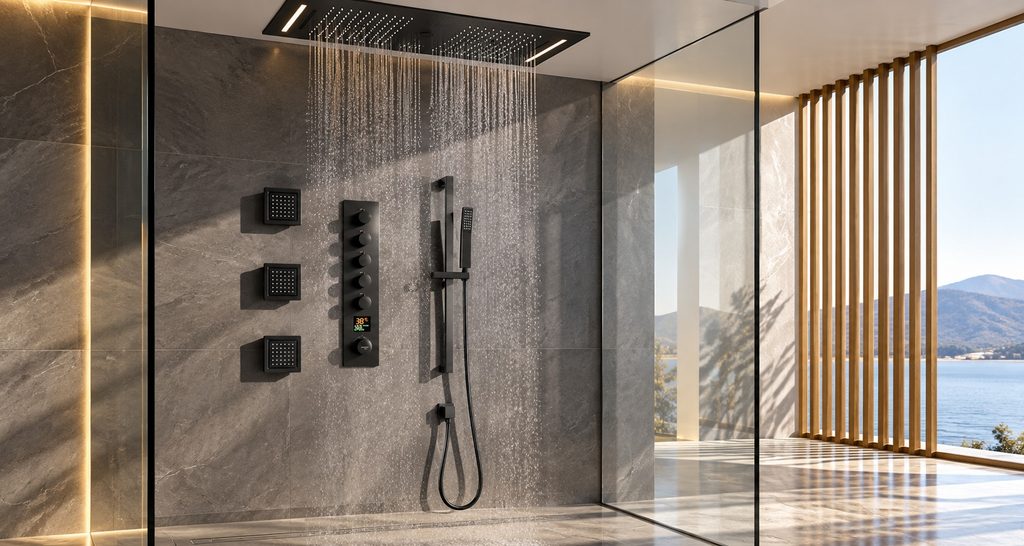
HospitalityShower.com editorial shower-system reference image.
Quick Answer
What should trigger a hotel shower refurb?
Move a room or room group forward when evidence points to declining shower performance, safety/compliance risk, repeated service calls, unavailable replacement parts, or a renovation scope that already exposes the valve wall. Treat visual refresh as a separate decision unless the mechanical work and finish work can be combined efficiently.
Complaint Logs
Guest complaints can reveal mechanical problems before an inspection walkthrough does.
Pull bathroom and shower complaints by symptom and probable root cause instead of sorting only by room number. Pair that log with maintenance tickets, room type, valve family and installation date where those records exist.
Temperature swings
Investigate pressure-compensating or thermostatic valve operation, supply pressure changes, limit settings and cartridge condition rather than assuming the complaint is cosmetic.
Weak or uneven flow
Check showerhead buildup, flow restriction, available dynamic pressure, supply conditions and valve performance before replacing the visible fixture alone.
Stiff handles or diverter leakage
Recurring control complaints often justify targeted inspection of cartridges, diverters, seals and internal valve components.
A refreshed finish cannot correct unstable mixed-water temperature, a worn control cartridge, inadequate pressure or an incorrectly sized shower system. Diagnose the symptom before assigning the room to a cosmetic renovation package.
Component Condition
Do not use one universal replacement interval for every cartridge, valve or showerhead.
Service life varies with manufacturer design, cycle count, water chemistry, debris, operating temperature, maintenance history and local conditions. A fixed “5-year” or “10-year” replacement rule can therefore be misleading unless it comes from the actual manufacturer or a property-specific maintenance standard.
Build the capital plan around condition indicators: recurring service calls, inability to hold temperature, damaged control movement, leakage, part obsolescence, visible scaling, measured flow and manufacturer service guidance.
Showerheads belong in a different maintenance category from concealed valves. They are accessible, easier to clean or replace, and their flow can be checked directly. For U.S. projects, the federal showerhead maximum is 2.5 gpm, while WaterSense-labeled showerheads are limited to 2.0 gpm and must also meet performance criteria.
Example showerhead collection for product comparison ↗
Decision Matrix
Use condition-based triggers instead of unsupported universal service-life numbers.
The table below converts the original calendar-based approach into a more defensible facility-management decision framework.
| Component | Condition trigger | Typical guest / maintenance symptom | Recommended action |
|---|---|---|---|
| Pressure-balancing or thermostatic valve | Fails to maintain stable outlet temperature, has repeated internal service, or does not align with current project requirements | Temperature swings, inability to set comfortable temperature, repeated adjustment | Test valve performance; service or replace using manufacturer instructions and adopted code requirements |
| Cartridge / compensating element | Recurring temperature-control issues, stiffness, leakage, contamination or manufacturer-directed replacement | Drift, difficult controls, inconsistent response | Inspect and replace the service component before assuming the entire valve body must be replaced |
| Showerhead | Measured flow/spray degradation, mineral buildup that cannot be restored, damage, or efficiency upgrade | Weak spray, uneven coverage, visible buildup | Clean, descale or replace; verify rated flow and applicable efficiency requirements |
| Diverter | Cross-flow, leakage to inactive outlet, stiff or unreliable switching | Water continues from tub spout or wrong outlet | Service cartridge/diverter and confirm compatibility before opening finished wall |
| Trim / finish | Finish degradation, damage, outdated room standard or inability to source compatible trim | Primarily visual unless controls are affected | Combine cosmetic replacement with mechanical work when doing so reduces room-down time |
Occupancy & Phasing
Set the number of rooms offline from forecast data—not a generic percentage.
There is no universal “safe” percentage of rooms to remove from inventory. The workable number depends on forecast occupancy, group blocks, room-type mix, event compression, crew logistics, water-isolation zones and the property’s tolerance for displacement.
Map demand
Overlay forecast occupancy, group commitments, room-type demand and high-compression dates before assigning renovation phases.
Map plumbing zones
Identify rooms sharing branches, risers, manifolds or shutoffs so construction does not unintentionally affect occupied rooms.
Phase by work area
Where practical, group rooms by floor, wing or plumbing zone to simplify access, protection, housekeeping and trade movement.
Hold a recovery buffer
Do not release rooms until testing, punch-list corrections, curing/finish requirements and housekeeping turnover are complete.
- Confirm which rooms share water-isolation zones before setting the final sequence.
- Keep a project-specific buffer between phases for testing and punch-list work rather than assuming every room returns exactly on schedule.
- Track guest sentiment and work-order frequency during the refurbishment period separately from the property’s normal operating baseline.
Code & Safety
ASSE 1016 is a product-performance standard—not a universal replacement deadline.
The current ASSE 1016 / ASME A112.1016 / CSA B125.16 standard addresses automatic compensating valves for individual showers and tub/shower combinations. It covers devices intended to control outlet water temperature for showerheads, hand showers, body sprays and related tub/shower fittings.
Whether a renovation legally triggers replacement of an existing valve depends on the code adopted by the project jurisdiction, the scope of work, local amendments and the authority having jurisdiction. Do not state that every older valve must automatically be replaced merely because a newer standard exists.
For each property, compare the exact installed valve and proposed renovation scope with the currently adopted plumbing code and local requirements. Where compliance or safety is uncertain, involve the plumbing engineer, contractor and authority having jurisdiction before finalizing the capital plan.
ASSE product standards ↗
Trade Sequencing
Reduce room-down days by resolving rough-in and compatibility before demolition starts.
The expensive delay is usually not the trim itself—it is discovering after demolition that the new valve, trim, wall thickness, waterproofing or supply arrangement does not match the approved room condition.
Verify the assembly
Lock valve body, cartridge, trim, showerhead, diverter, accessories and rough-in dimensions before opening the wall.
Plumbing first
Complete valve, supply and drainage corrections while access is available and before finish work closes the assembly.
Test the system
Pressure-test and verify operation, temperature control and limit settings according to manufacturer instructions and project requirements.
Trim, function test, clean
Protect finish components until late in the sequence, then complete final function testing before housekeeping receives the room.
Pre-Refurbishment Checklist
What facility teams should assemble before approving the next phase.
- 01Complaint history by symptom
Separate temperature, spray, drain, control and cosmetic complaints instead of treating “shower issue” as one category.
- 02Work-order history
Identify rooms or valve families generating repeated cartridge, diverter, leak or temperature-control calls.
- 03Installed product records
Collect valve model, cartridge/repair part numbers, trim family, installation date and manufacturer documentation where available.
- 04Water-quality conditions
Review hardness, scaling and debris history because these can materially affect service frequency and showerhead performance.
- 05Measured performance
Check outlet temperature behavior, available flow/pressure, diverter function and visible leakage in representative rooms.
- 06Code / AHJ review
Confirm the currently adopted requirements and whether the planned scope triggers upgrades or replacement.
- 07Inventory and lead times
Do not demolish before critical valves, cartridges, compatible trim and long-lead components are secured.
- 08Occupancy and isolation plan
Coordinate room blocks, plumbing zones, shutoffs, construction routes and contingency rooms with operations.
Showerhead Efficiency
Use a refurbishment to verify flow—not just change finishes.
EPA states that the U.S. federal showerhead standard is 2.5 gpm, while WaterSense-labeled showerheads are independently certified at no more than 2.0 gpm and must satisfy additional performance requirements such as minimum flow, spray force and coverage.
That makes showerhead replacement a useful point to verify actual project requirements, local water-efficiency rules and guest-experience targets rather than selecting by appearance alone.
EPA WaterSense showerheads ↗WaterSense applies to eligible showerheads, rain showers and hand-held showers under its specification; body sprays are outside the WaterSense showerhead specification. Verify the complete shower configuration rather than assuming every outlet carries the same efficiency label.
Verified Resources
Use standards and current manufacturer data to support the capital plan.
These external sources are appropriate starting points for code, showerhead performance and product comparison. Local adopted code remains controlling for an actual project.
Includes ASSE 1016 / ASME A112.1016 / CSA B125.16 for automatic compensating shower valves.
Current ASSE listing describes the harmonized standard and its scope for individual showers and tub/shower combinations.
Efficiency and performance information for WaterSense-labeled showerheads.
Current specification resources and product-category information.
Commercial product collection retained from the original article as an example shopping/reference source; verify exact product certifications before specification.
Internal research on pressure, flow, thermostatic control, drainage and plumbing coordination.
Continue the Research
Connect refurbishment timing to system design, procurement and long-term operation.
Capital Planning Takeaway
Prioritize the rooms with evidence of mechanical risk—not merely the rooms that look oldest.
Before finalizing the next refurbishment calendar, combine complaint logs, work orders, installed valve data, field testing, water conditions, adopted code requirements, component availability and occupancy forecasts. That produces a stronger capital plan than relying on a universal age threshold or cosmetic inspection alone.
Where complaint tags suggest pressure or temperature instability, have a qualified plumbing professional verify the system before the next renovation phase. A correct diagnosis can determine whether the scope is a serviceable cartridge, a showerhead problem, a valve replacement or a broader water-system issue.